
Divemaster Internship or Divemaster Course? What to Know Before You Choose

If you search for Divemaster training in the Philippines, you will quickly come across the word “internship”. It sounds like a great deal: you help out at a dive centre, and in return you become a PADI Divemaster. Before you choose a programme, it helps to know what that word usually means here, and why we run Divemaster training as a proper course.
What “internship” usually means in the Philippines
Most programmes advertised as Divemaster internships in the Philippines still charge a fee. When we looked at the internship offers that come up first on Google, every one of them had a price. In most cases the word describes a longer programme where you spend your days in a working dive centre, which can be a very good way to learn.
What is rare here is the version many people imagine: free Divemaster training in exchange for working in the shop. In our experience, very few dive centres in the Philippines offer it, and there are good reasons why.
Why free work-for-training rarely makes sense here
It saves a dive centre very little
Local salaries in the Philippines are fairly low, so local staff are not a big part of a dive centre’s costs. Replacing them with unpaid trainees would save the business very little. In return, the centre would lose experienced crew who know the boats, the dive sites and the guests, and swap them for people who leave after a few weeks.
Local jobs support local families
Boat crew, dive guides, compressor operators and shop staff are more than names on a roster. These jobs are livelihoods. They pay for school, food and homes for families in the community. Handing that work to visiting foreigners for free would take it away from the people who live here, and most dive centres we know do not want to do that. We certainly don’t. Our local team is the reason the dive centre runs well every day.
Somebody still has to teach you
Divemaster training takes a lot of time from experienced instructors: briefings, skill workshops, feedback after dives, assessments and plenty of patience. Those instructors need to be paid too. When the trainee pays nothing, there is a real risk that the teaching becomes an afterthought. The trainee carries tanks and fills gaps in the schedule, and nobody has the time to actually train them. That is free labour, and it is not the standard we want for the dive professionals we send out into the world.
What a good Divemaster course gives you
Paying for your training should mean you are trained properly. Wherever you choose to do it, this is what a good Divemaster course should give you.
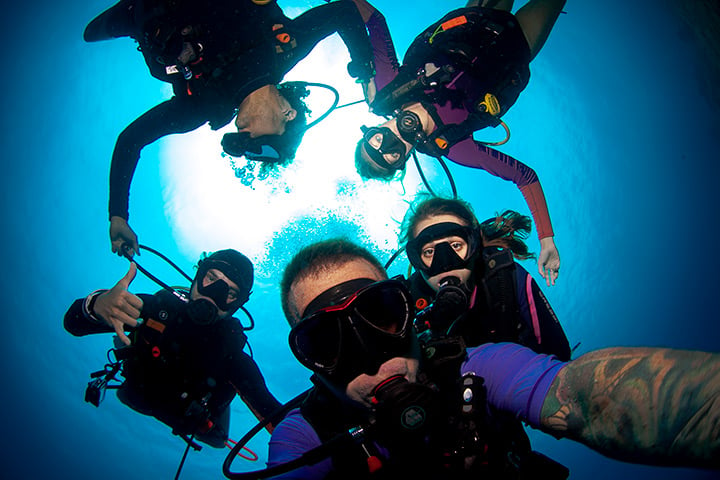
You become a much better diver
Your buoyancy and trim get sharper, your air consumption drops and your skills reach demonstration quality, the level you need to show them to students. You learn to navigate with confidence, plan dives and stay calm when something does not go to plan.
Lots of diving
Diving is how you get good at diving. During your Divemaster training with us you can join as many dives as you like on our regular dive schedule in Dauin (marine sanctuary fees are extra). Every dive is a chance to practise, guide and learn the sites.
Confidence with people
You learn to give clear dive briefings, look after groups, assist instructors with real students in confined and open water, and handle rescue scenarios. By the end, standing in front of a group of divers feels normal.
A real look inside the dive industry
You see how a dive centre works behind the scenes: planning the day, preparing equipment and boats, looking after guests, and the safety side, including an emergency assistance plan with the route to the hyperbaric chamber in Dauin. It is the best way to find out whether a career in diving is right for you.
Experiences you keep for life
Early mornings on the water, the frogfish you find on your own for the first time, the first student who thanks you after a dive, and the friends you make along the way. These are the memories that stay with you long after the course. If you want the honest, slightly sweaty version, read what nobody tells you about Divemaster training.
How Divemaster training works with us
- It usually takes about 6 weeks. If you want more time, extra weeks are PHP 5,000 each.
- The training costs PHP 60,000. PADI’s Divemaster application fee is separate (AUD 286 in 2026) and is paid to PADI.
- To start, you need to be a PADI Rescue Diver (or equivalent) with Emergency First Response training from the past 24 months, at least 40 logged dives (60 by the time you certify), a medical statement from a doctor, and be at least 18.
- Planning to become an instructor? The Divemaster + IDC package is PHP 160,000, which is PHP 10,000 less than booking both separately.
You will help on real courses, because that is how you learn the job. The difference is why you are there: to be trained, with instructors who take the time to teach you and give you feedback, rather than to cover for a missing staff member.
See everything that is included on our PADI Divemaster page, or work out your total, including a trainee room, with the cost calculator.
Questions to ask before you sign up anywhere
- What exactly is included in the price, and are PADI’s fees extra?
- How many dives can I do, and do some dive sites cost extra?
- Who teaches me, and how much of my time is spent learning compared with working?
- How long does the training usually take, and what happens if I need more time?
- Where will I stay, and what does it cost?
A good dive centre will answer all of these clearly. If you would like to ask us, send us a message and tell us about your diving so far. We will help you work out the best way to your Divemaster rating.
